
Freedom from Slavery Global Forum
Opening Keynote
Nairobi, Kenya
Monday, 5 October 2026
John Richmond, Atlas Free’s Chief Impact Officer, Former U.S. Ambassador to Combat Trafficking
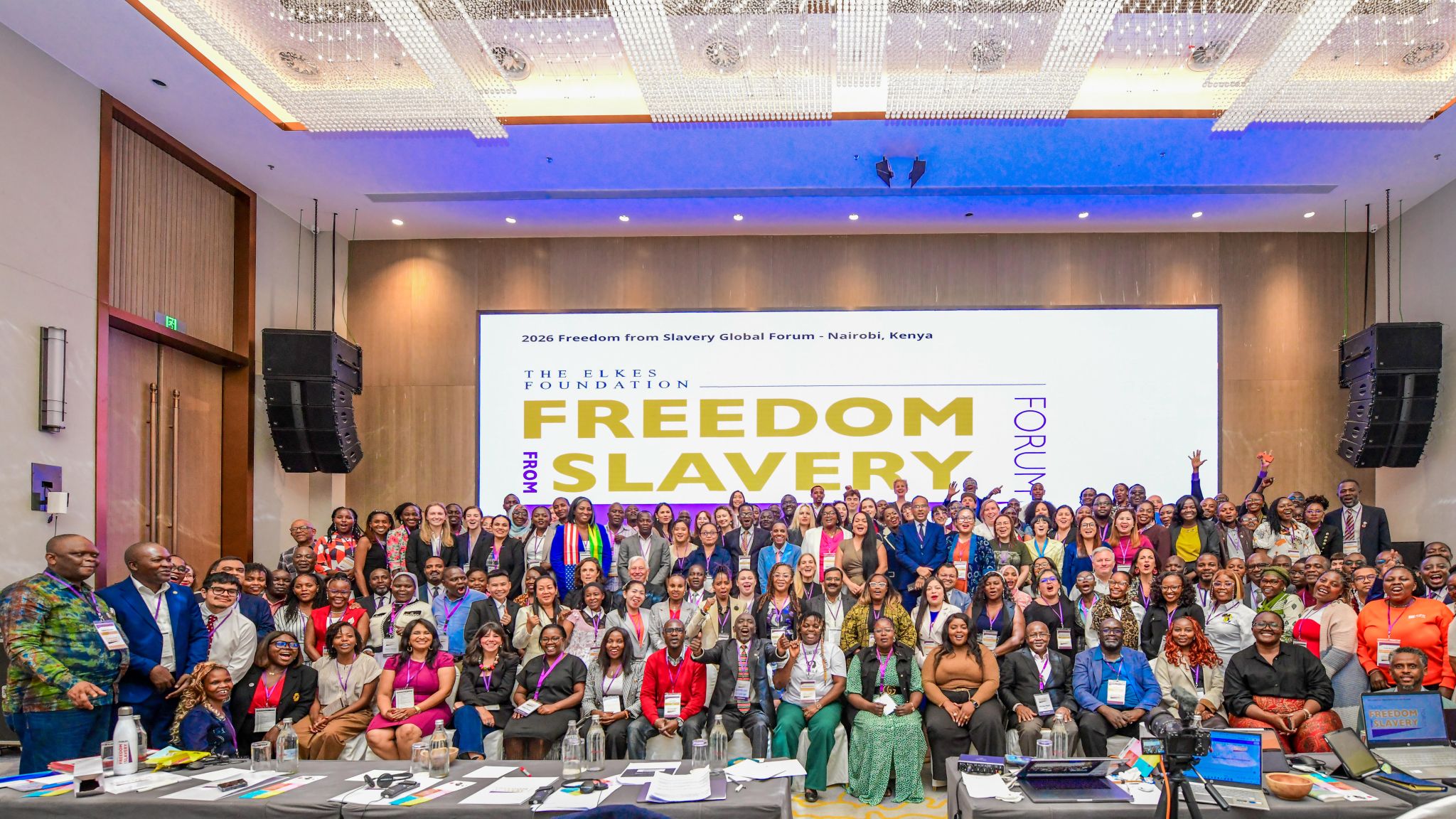
The following remarks were delivered by John Richmond, Atlas Free’s Chief Impact Officer, Former U.S. Ambassador to Combat Trafficking, as the opening keynote at the Freedom from Slavery Global Forum in Nairobi, Kenya, on October 5, 2026. Organized by Free the Slaves, the forum brought together survivor leaders, governments, civil society, businesses, and UN agencies from around the world under the theme “Freedom in a Changing World: Strengthening Protection, Accountability and Transforming the Systems Behind Modern Slavery.” His remarks, as prepared for delivery, are below.
We gather at this Global Forum on Modern Slavery during a time of change, when many people are discouraged. We know that human trafficking is a crime. We know the fight against slavery and for freedom is a righteous cause. We know that the criminals, countries, and corporations who traffic people commit a great evil. We know that those who do not get to decide where they work or who touches their bodies should be free to compete for work and choose their own sexual partners. We know we have made tremendous progress, and we know how much is left to be done.
And yet, many feel the pace of progress may have slowed or even drifted backward. It seems that this Nairobi gathering has come at just the right time, providing a moment to exhale and reflect. Before we assess where the anti-trafficking world stands today and what the future holds, we should ground ourselves in the truth about the past. Remembering how we got here can offer perspective and hope. Indeed, history is the future’s prologue.
The Past
So, let’s consider the past. Most of history has been the story of empire. As Czars, Kings, Pharaohs, Führers, Emperors, Sultans, Emirs, Shahs, Khans, Moguls, Party Chairmen, Despots, and Potentates ebbed and flowed across the earth, the people living where they controlled belonged to them. They owned them. People were subjects. Often, they could not own private property or freely assemble. They could not select their faith, or express it, or reject it. Free speech, labor rights, the ability to organize, start a business, or publish a poem were fictions.
There was no “human trafficking movement” during these 3,700 years of recorded history. The strong did as they willed, and the weak accepted what they must. Sex trafficking was the norm. Both criminals and governments regularly forced men and women, from near and far, to endure commercial sex acts for which their consent was never a consideration. Forced labor was a feature, not a bug, of empires.
The words used to describe human trafficking varied from continent to continent, but the system was always basically the same. The government, not the individual, chose where, when, and how people worked, and if there would be any compensation for their labor. The historian David Eltis explains, “almost all peoples have been both slaves and slaveholders at some point in their histories.” This idea deconstructs the narrative that trafficking’s history is merely the story of villains and victims, oppressors and oppressed. Owning others and controlling their bodies and labor was history’s default setting.
Then history took a turn. To be clear, it didn’t turn on its own. It turned because of lawyers, advocates, diplomats, business leaders, legislators, faith leaders, and reformers. It didn’t happen with a single vote, battle, or campaign. It was a long season when the principles of natural law shouted at empires that every person has inherent value. It was the age of reason informed by faith that demanded individual rights, in and of themselves.
The idea that every person matters on their own; and they do not exist to serve the collective, the state, or the crown. This radical new belief splintered the dominant religious institutions during the Reformation and challenged the increasingly predatory colonial powers. Indeed, Plato, Aristotle, and Aquinas’s pursuit of the “good, true, and beautiful” was made whole with an embrace of human dignity.
The barbaric trans-Atlantic slave trade was an inevitable casualty of the inherent value principle. It was destined to fall because human dignity demands freedom. This inspired the Clapham sect to bring down the UK’s slave trade in 1807 and advance emancipation in 1833.
It gave us the 1926 League of Nations Slavery Convention (which celebrates its 100th birthday this year). Human dignity centered the 1948 Universal Declaration of Human Rights around the truth that governments get their legitimacy from the consent of the governed, that family is the essential political unit, that religious freedom is necessary, and that slavery in all its forms is morally wrong.
The focus on inherent human value led to the UN’s Palermo Protocol, along with the United States’ Trafficking Victims Protection Act. And now, on the shoulders of a few centuries of academics, agitators, and advocates, we stand in a world where virtually every country has some sort of law against human trafficking. It is a grand legal consensus, representing a 180-degree pivot from the past. The belief that every person from everywhere, regardless of station or status, regardless of abilities, aptitudes, or affiliations, possesses a full measure of human dignity, serves as the foundation for human rights.
Human dignity also took aim at history’s treatment of women. Empires denied women the right to vote, own property, testify in court, initiate divorce, or decide if they wanted to wear a hat. New Zealand is credited as being the first country to allow women to vote in 1893. That is only 133 years ago. The world enjoyed the steam engine, telegram, telephone, railroad, and lightbulb before the first country granted women’s suffrage. Man had already walked on the moon when Starbucks Coffee opened in 1971; the same year, Switzerland extended full voting rights to women. Portugal granted women’s suffrage in 1976, the same year Steve Jobs, Steve Wozniak, and Ronald Wayne started Apple. These advances of individual rights are absurdly recent. Gender discrimination still exists, and getting the vote doesn’t fix everything. Yet, the compelling campaigners over the last 200 years deserve applause for moving the culture and the law in the right direction.
Perhaps the most striking example of how we have elevated from the past centers on global poverty. The World Bank now defines “extreme poverty” as living on less than the equivalent of $3.00 US dollars a day.
The World Bank reminds us that in 1820, about 79% of the world’s population lived in extreme poverty. That is a huge percentage. The poverty rate today hasn’t just declined; it has plummeted. Only 10% of the population lives in extreme poverty today. That is an almost 87.3% reduction in the global extreme poverty rate! Let us cheer that 90% of the global population isn’t in extreme poverty. Incredible progress.
In the same period, the Earth added over seven billion people. This isn’t just an illusionist’s trick with percentages and ratios; the absolute number of people in extreme poverty today is lower than it was 200 years ago, even though the population is eight times larger. Similar striking improvements exist in education, literacy, democracy, and child survival. Individual rights that restrain governments from interfering with our assemblies, speech, press, markets, or property rights have gained strength.
Harvard Professor Steven Pinker reminds us that, “Life has been getting better in pretty much every way. . . There has never been a better time to be alive.” This positive message is not what we receive from the media or politicians whose business models rely on everything being a “catastrophe” or “existential crisis.” Still, the radical progress over the last two or three centuries is encouraging because this progress didn’t occur by accident, happenstance, or chance. It was the result of hard work and dedicated people who overcame one adversity after another. Driven by human dignity, they challenged the status quo and fought to make real what did not yet exist.
Of course, the work remains unfinished. For the person withering in extreme poverty today, this positive historic arc will not satisfy their hunger. For the mother burying her infant, the general decline in infant mortality is of little comfort.
Yet, we are here to address systems and consider the movement, and these positive long-term trends should soothe us during a season of disruptive change.
Professor Pinker is quick to highlight that although all this progress is real and meaningful, it is not guaranteed to last. Gains can be lost. Governments have failed. Schools have shuttered, books have burned, families fractured, and property seized. Societies of the past have lost their way. It will be up to us to keep the gains and make future advances. Things are getting better, better than ever before, and this improvement is new. Our present human trafficking landscape bears little resemblance to the past. We have come a long way.
Present
Let’s shift from the past to the present, because we live in the complicated terrain of our time. Our present challenge is not getting the world to agree that sex trafficking and forced labor are wrong. We enjoy a grand consensus on the big ideas. Our chief challenge is not agreement; it is implementation.
The International Labor Organization estimates that traffickers exploit 27.6 million people in forced labor and sex trafficking. That is up 10% from the prior global estimate. Meanwhile, traffickers’ profits are soaring. Traffickers are raking in $236 billion a year. Trafficking is big business. Meanwhile, countries last year reported identifying 102,027 victims. When compared to the 27.6 million victims suffering, we identified only .3% of victims. That is less than half of one percent, leaving 99.7% of victims exploited.
Traffickers continue to operate with impunity as conviction rates drop, and many countries fail to hold traffickers accountable even if convicted. Courts issue suspended sentences where traffickers receive virtually no punishment, while survivors receive no suspension of their trauma. Governments divert human trafficking cases into administrative labor violations that neither hold traffickers accountable nor support survivors. What does it say to survivors that culture punishes people for stealing a car, but not for trafficking a person?
Changes in government funding patterns around trafficking have been disruptive at best and devastating at worst. Even where funding under existing grants has continued, new funding opportunities are limited. Pew’s Research shows a significant drop in US foreign assistance grants from about $80B to a projected $7 billion in the last two years. Other countries are also reducing their foreign assistance. Interestingly, these reductions still leave the United States as one of the world’s most generous countries when providing foreign assistance.
This pattern will present challenges for several more grant cycles. Many have turned to private philanthropy and generous family offices to continue vital programs. Still, some employees have lost their jobs, and some survivors have lost access to services. We know that funding priorities change with the seasons, and organizations are not entitled to perpetual funding, but these shifts were abrupt and difficult to absorb.
Structural changes in governments’ approach to trafficking also raise concerns. Offices that once led on this issue have been removed from organizational charts and demoted. Some offices have not just been reduced in size but deleted altogether. Whether intentional or not, these decisions effectively deprioritize this important issue, with cascading downstream effects. It can feel like everything is going in the wrong direction. Prevalence is up, profits are soaring, identification is anemic, impunity persists, funding is declining, and structures are altered.
Another challenge we face today is focus. As you know, human trafficking naturally intersects many other issues, from immigration to refugees, poverty to education, worker rights to vulnerability reduction. Climate, public health, conflict, and unionizing all intersect. All of these are important and interesting issues and worthy of attention. Indeed, many have their own UN offices, treaties, protocols, conferences, and funding sources.
Although the overlap between migration and trafficking exists, it is certainly not coextensive, and we should not relabel immigration enforcement as anti-trafficking activities any more than we should relabel poverty alleviation and vulnerability reduction as an anti-trafficking intervention. The anti-trafficking movement should appreciate the intersections with other issues, but not lose focus on protection, prosecution, and prevention. These three Ps are intertwined and interdependent. None should be dismissed, dismantled, or deleted. A silver lining of our present is that more survivors are part of the conversation and leading the conversation. Their ideas, insights, and opinions matter. They are living testaments to resiliency, a trait we all need during this season.
But the present we just considered will not be our future. The holders of power cannot cling forever. The status quo is impossible to maintain. Today’s elite athlete will not be the elite in 2036. The status quo is like an ice cream cone on a hot summer day. You can either enjoy it or end up with a sticky mess. Change is coming for better or worse.
The Future
The question is not whether our present will change. The question is, “What will it become?” The answer lies within us. We each have agency. Instead of seeing ourselves as the “victims” of recent changes, we can position ourselves as “guides” to help organizations, agencies, and individuals build. You do not need permission to build; you don’t have to wait your turn; you can compete in the area.
I think the future of combating human trafficking depends on three things. First, our hard work. It will require effort because excellence is not easy. Hard work secures and maintains freedom and justice. The absence of sustained hard work sets freedom and justice in peril. Second, adaptability. With creativity, we must flex to meet a new environment. Change is perpetual, and we must rise to the occasion. And third and most importantly, virtue. First principles and character should drive us to know and do what is right and good. Hard work, adaptability, and virtue are the path to the future where minds, markets, and people enjoy freedom.
The alternative is lament. Lament is understandable, even appropriate at times. There are seasons for lament. But lamenting, blaming, and complaining are not strategies. Describing what we think is wrong with systems and people can be useful at times, but its utility diminishes with frequency. At some point, we must pivot. We must adapt to the current funding streams and structures, and plan to build the ones we want in the future.
We must recognize that this is a broad, heterodox movement. There is wisdom in subsets of the movement focusing on different, albeit complementary, intermediate goals. Some might focus on forced labor in the chocolate industry. Others might focus on the scam centers. Someone should be working to stop state-sanctioned forced labor, whether it is China’s exploitation of the Uyghurs or Sudan’s conscription of child soldiers. Others might focus on those purchasing commercial sex or those compelled to sell sex. Online sex trafficking and brutal non-consensual pornography are gaining more attention, as is generative AI’s creation of CSAM. Some might focus on victim identification, while others focus on perpetrator accountability. Still others might seek to prevent the crime before it happens. System reform and policy advancements are required.
People within the movement can even disagree with one another. There are different approaches, schools of thought, and preferences. But let us never forget that we agree on the essentials. We should be a community known for our generosity and hospitality, more than adherence to the current orthodoxy.
The movement is not a chorus that must sing in unison, where every voice proclaims the same note. It is not even a symphony where we all play different instruments under the direction of a central conductor. Fighting for freedom is more like jazz. We all agree on the basic key, and then everyone riffs. Some have brief solos, sometimes there is harmony, and other times dissonance, but ultimately, we are working toward the resolution of freedom.
Conclusion
During this Forum, let the incredible progress of the past inspire us. The freedoms we currently enjoy are historically new, and we should not take them for granted. We receive them as a sacred trust to shepherd, cultivate, and improve during our season of leadership before time calls upon us to hand them off to others. Let’s also be honest about the difficulties and challenges the present presents. Let’s be encouraged that the present’s status quo will not be the future because the future is up to us. So let us not grow weary of doing good or succumb to cynicism in the present. Together, with hard work, an adaptable posture, and a firm grip on virtue, we can forge a future of freedom.
Sources:
1 David Eltis, The Rise of African Slavery in the Americas (Cambridge: Cambridge University Press, 2000), xiii.
2 World Bank, “June 2025 Update to Global Poverty Lines,” fact sheet, June 5, 2025, https://www.worldbank.org/en/news/factsheet/2025/06/05/june-2025-update-to-global-poverty-lines. The update raised the extreme poverty line from $2.15 to $3.00 a day; in 2015, it was $1.90 a day.
3 OECD. How Was Life? Volume II: New Perspectives on Well-being and Global Inequality since 1820. Paris: OECD Publishing, 2021. https://doi.org/10.1787/3d96efc5-en.

